SN Reservoirs 0700-0915 MJP, LP
o/c, bright, mild. light-mod SW.
Redwing - 4 (s)
Barn Swallow - 3 (sw)
Meadow Pipit - 1
Chiffchaff - 1
Siskin - 1
Reed Bunting - 3 (sw)
Chaffinch - c15 (sw)
Greenfinch - 25
Comma - 1
Brooke Road, N16 (1450) - Swallow - 3 (s)
another quiet morning, but brightened up by the autumn's first Redwings (two singles and a pair) heading south. Otherwise, little in the way of visible migration, although for the second day this week, Reed Buntings arrived high from the NE and dropped in temporarily before heading south.
Monday, October 09, 2006
Sunday, October 08, 2006
7th October 2006
SN Reservoirs 0650-1030hrs MJP, LP
cool, sunny. Brisk W.
Lesser Redpoll - 1
Meadow Pipit - 16 (over)
Wigeon - 1
Sand Martin - 34 (sw)
House Martin - 20
Greylag - 5 (w)
Black-headed Gull - 45
LBB Gull - 8
Kingfisher - 2
Gadwall - 50
Shoveler - 30
A quiet (and cold) morning on patch, with no grounded migrants but for a Lesser Redpoll (in from the south). 34 Sand Martins moved SW at first light, with 20 House Martins soon after (many of which hawked insects around the reservoirs for several hours). A solitary Wigeon was present, Gadwall and Shoveler numbers are high, and five Greylags were the first to be recorded for several months.
Migrant Hawkers are still out in force, and at least 15 Red Admirals moved through.
cool, sunny. Brisk W.
Lesser Redpoll - 1
Meadow Pipit - 16 (over)
Wigeon - 1
Sand Martin - 34 (sw)
House Martin - 20
Greylag - 5 (w)
Black-headed Gull - 45
LBB Gull - 8
Kingfisher - 2
Gadwall - 50
Shoveler - 30
A quiet (and cold) morning on patch, with no grounded migrants but for a Lesser Redpoll (in from the south). 34 Sand Martins moved SW at first light, with 20 House Martins soon after (many of which hawked insects around the reservoirs for several hours). A solitary Wigeon was present, Gadwall and Shoveler numbers are high, and five Greylags were the first to be recorded for several months.
Migrant Hawkers are still out in force, and at least 15 Red Admirals moved through.
Friday, October 06, 2006
September 2006 - summary
Highlights:
Black-tailed Godwit - immature, 8th
Hobby - juvenile (11th) and adult (15th)
Spotted Flycatcher - 8 to 12 birds on six dates
Peregrine - one on 17th
Red-crested Pochard - two (from Aug) to at least 19th
Egyptian Goose - two on 13th, and again on 19th & 26th
Sandwich Tern - four over, 3rd
Rook - two on 29th
productive visible migration - inc. pipits, larks, wagtails, uncommon finches and waders
All records refer to Stoke Newington Reservoirs unless otherwise stated

Almost the entire month (but for occasional brief showery periods) was fine, dry and mild - indeed often very warm, with the now almost expected indian summer providing pleasant watching conditions and extending the season even longer than in recent years. Winds during the period were rarely strong, and almost without exception from the southerly half of the compass.
Time spent on patch - mainly at the reservoirs, but also in Clissold Park and Abney Park Cemetery - was stepped up during the period, and several hours were dedicated to observations almost every day. Watching at the reservoirs usually began around dawn - often the case anyway, but earlier starts being even more justified on account of the time of year - and time spent in Clissold Park was either at dawn (for grounded migrants, before too much disturbance) or during the day (for flyovers).
Activity during this period was rich and varied, with a strong cast of migratory species and some real surprises. Most notable records, as expected, came from the reservoirs, with a good mix of grounded migrants, waterfowl and flyovers/visible migration.

(Wigeon & Gadwall, 21st)
Wildfowl numbers (and the list of species) continued to grow, as birds from further north and the continent used the reservoirs as a moulting site and refuelling stop. September peaks included: Common Pochard, 61 on 5th; Northern Shoveler 32 on 26th; Gadwall, 40 on several dates; Tufted Duck, 80 on 6th; Ruddy Duck - c30 on many dates; Mallard, 27 on 15th.
Uncommon and/or seasonal wildfowl records were represented by several species. The first Wigeon arrived on the 12th, with a group of seven on the ER; thereafter, numbers varied as new birds arrived and others departed, with eight on 13th, nine on 15th, seven on 17th, eight on 19th, 13 on 21st, six on 23rd, five on 26th (including two new males), and one on 29th.

(imm. male Red-crested Pochard, 9th)
Red-crested Pochards continued their regular-as-clockwork autumnal presence, with two (immature male and female) arriving in the third week of August and remaining until at least 19th (the male being present for much of his moult from female-type plumage into less cryptic dress). With a few occasional exceptions in the winter, almost all records of this species in recent years fall within a short window of mid-August to late September.
Long overdue considering the species status in London, Egyptian Goose finally made it onto the local list, with a pair frequenting both reservoirs on the 13th, and again on the 19th and 26th. Numbers of Canada Geese swelled to record proportions, as the WR became a popular roosting site - dozens were counted leaving the site at dawn on several occasions, with top counts of 49 on 15th and 19th.
Great Crested Grebes were still attempting to breed during the last week of the month, with both birds occupying a freshly built nest; other individuals were often present, including odd juveniles on both reservoirs. Little Grebes maintained an unusually strong presence on the ER, with double figures on most days; a record 18 were recorded on the 21st. Young were still being shepherded away from gulls as late as the end of the month.
Grey Heron and Cormorant numbers swelled during the month, with often as many as 10 of the former and 40 of the latter recorded.

(Jackdaw passage, 29th)
Raptors were well represented, with Sparrowhawks being omnipresent, especially at the reservoirs; three or four individuals were often seen, and although local birds can't be ruled out, migrants were almost certainly involved. Kestrels were recorded fairly regularly, and a Peregrine early on the morning of the 17th was, perhaps surprisingly, the first record for several months.
The choice bird of prey of the month was undoubtedly Hobby; a juvenile on the 11th and an adult on the 15th both performed beautifully, giving great views over the ER. Both were recorded before 0900hrs, and neither loitered for longer than a couple of minutes.

The high water levels on both reservoirs - and the overgrown state of the WR's perimeter - meant hopes of passage waders dropping in, however briefly, were lower than ever. However, the bird of the month - and one of the most unexpected records in recent times - was an immature Black-tailed Godwit, which came in low from the west, calling loudly, just after dawn on the 8th.
Much to frustration of both the observers and the bird, there was nowhere for it alight; however, four or five exploratory laps low over the ER (with half-hearted attempts to land in several unsuitable corners) were completed before the bird departed to the south-east. The only other wader record for the month came with two Common Snipe, flying fairly high and north, on the morning of the 15th.


(Sedge Warbler, 23rd)
Gull numbers, and species, slowly increased as the month wore on, with Black-headeds dominating (as usual at this time of year); a handful at the beginning of the month became 15 to 30 by mid-month, and a peak of 55 on 21st was typical for the period. Lesser Black-backed Gulls were omnipresent in small numbers, usually between three and eight, and one to three Herring Gulls were recorded on most occasions.
An especially early Common Gull - an adult - was present on the gull pipes of the ER on 8th, and 2nd winters were briefly present (in the same place) on 19th and 29th. Tern passage was almost non-existent, with two Commons on 10th and, surprisingly, four Sandwich Terns on 3rd.
Woodpigeon passage was regular and prolonged during the month, with up to 200 recorded on several dates late in the month; Stock Doves also passed through in small numbers, with a peak of six on 21st. Late Common Swifts were recorded on 5th (three) and 6th (one over Clissold Park). Kingfishers were ubiquitous, with two or three seen on most visits; ditto Great Spotted and Green Woodpeckers, with at least one or two of each usually present at all sites.
Hirundines ebbed and flowed throughout the month, although with few defined peaks, and double figure counts of any of the three species were uncommon. In contrast to last September, Barn Swallows were often the most numerous, with several counts of between 10 and 15, with a peak of 19 on 19th.

(Carrion Crow & Magpie harrassing Sparrowhawk, 29th)
House Martins were uncharacteristically scarce, with single figures at best, but for an isolated peak of 65 (also on 19th). Sand Martins were also regular but hardly numerous. (All three species were recorded on 29th, hopefully not the last of the autumn).
Skywatching for flyovers was, however, very productive. Pipits, wagtails, finches and larks complimented movements of Woodpigeons (and Starlings), and early morning sessions at the reservoirs were often rewarded with the sight and calls of relatively uncommon migrants overhead.
Species which were previously considered scarce or vagrant were encountered (through patience, and often blank hours) performing visible migration on many occasions. Generally speaking, the most productive time was from about half an hour after dawn until around 0900, and often depended on conditions; some days were blank, others were enlightened by quality, quantity or both.
Two Skylarks over on the 19th were the first of the year, but the most impressive counts involved Meadow Pipits. From the first autumn record (of three on the 15th) to the month's end, a total of 175 were recorded, eclipsing counts of previous years by many times. Peaks of 73 on 23rd and 55 on 26th were indicative of strong movements throughout the last fortnight.
Tree Pipits, previously barely annual in the area, totalled three for the month; all records, on 15th, 17th and 19th, involved calling flyovers. Wagtails of all three British species were also involved in movements; four Yellows were perhaps the highlight, with singles on 11th, 19th, 23rd and 26th.

(Spotted Flycatcher, 5th)
Both Pied and Grey Wagtails were also on the move, although counts were blurred by 'resident' birds - several of each being normally present around the reservoirs; peaks of 10 Pieds (on 23rd) and six Greys (on the 8th) probably reflected conservative counts, and both species were seen flying over at height on many occasions.
A single Northern Wheatear flew west over Clissold Park on 8th.
Robin numbers swelled during the middle of the month especially, with around 15 often recorded, usually coinciding with small influxes of Blackbirds, up to 40 of which were seen on several dates.
Song Thrushes, a fairly scarce local bird with only one confirmed breeding pair on site, also became more numerous, with up to 20 birds on several dates mid-month. Mistle Thrushes also became far more evident, with - in common with last year - presumably the same flock of up to 25 birds pre- and post-roost at the northern edge of the site.
Warblers, while rarely present in any great volumes (unlike last autumn's heavy influxes), kept things interesting, with all the common species moving through. Sedge Warblers, absent for the first ten days of the month, unexpectedly reappeared from the 11th; one's and two's were seen on several dates, with a peak of three on 23rd. One sang at dawn on 15th, and the last record was of two on 26th.

(Egyptian Geese, 13th)
Reed Warbers maintained a constant presence, with five to ten often recorded, and a peak of 12 on 12th; fewer were seen at the end of the month, but again, several birds sang on warm, clear mornings. All four Sylvia warblers were recorded, with Blackcaps predictably the most evident. One or two were seen on most occasions, with peaks of five on 5th and 8th, and three on 23rd.
A single Garden Warbler was at the ER on 13th, again, surprisingly in full song for much of the day; Lesser Whitethroats were recorded on 17th (one) and 19th (two), and a single Common Whitethroat was seen on the 5th.
Willow Warblers peaked in the first week of the month, with 18 on 5th and 12 on 8th, with numbers then decreasingly rapidly; singles were seen on most occasions thereafter, with a last record of one on 23rd.
Chiffchaffs, as expected, peaked later, and were still being recorded in fairly good numbers at the end of the month. Four to ten were not unusual throughout, with peak counts of 20 on 8th (16 at ER, 4 in CP) and 12 on 15th. Both species, once again, were singing on many occasions.
Goldcrests were typically seen or heard on about every other visit, with juveniles present on several dates mid-month. Spotted Flycatchers were a real highlight of the month, with at least eight (probably 10-12) birds recorded between 4th and 12th. Favoured sites included the deer enclosure and lakeside areas in Clissold Park, and the southern and north-eastern areas of the East Res.


(Hobby, 15th)
Tit flocks around the sites, especially along the New River east, predictably grew in strength through the month, with up to 30 Long-tailed Tits along with many Blues and Greats. Flocks often contained Phylloscopus and odd Sylvia warblers (but as yet, no Treecreeper or Firecrest....)
Corvid movements were especially evident during the last week of the month, by which time Jays numbered up to ten on several visits in and around the Oaks of the ER, and also in Abney and Clissold. Counts of Carrion Crows began to build mid-month, with up to 50 passing over on several days by the last week.

(Migrant Hawker, 9th)
Jackdaws, a scarce but regular autumn migrant, were recorded on 26th (six, west) and 29th (eight, west); two Rooks - a veritable vagrant in the area - were a pleasant surprise, also on 29th.
Starling numbers rose in accordance, often coinciding with high counts of Woodpigeons and Carrion Crows; over a hundred a day wasn't unusual by the last ten days of the month. House Sparrows remain omnipresent along the eastern fringe of the ER, where the flock presently numbers around 25.
Finches provided a few hard-earned highlights during visible migration watches (although hopefully October will provide more); Greenfinches were the commonest, with peaks of 60+ on 19th, 50 on 21st and 29th, and a 'local' flock of around 25 present from mid-month. Chaffinches were also on the move, with double figures over on some days, and more birds present around the ER by the end of the month.

(Spotted Flycatcher, 5th)
Siskins featured comparatively well, with two on 5th, eight on 17th, seven on 19th, two on 26th and one on 29th (mostly overhead calling but occasionally grounded), while Lesser Redpolls were recorded on 26th (two by the ER) and 29th (one over). Two records of Linnets - a locally rare bird - were encouraging, with one over CP on 8th, and three over the ER on 19th.
Escapes: A blue-morph Budgerigar flew around the perimeter of the ER on 21st.
Mark
Black-tailed Godwit - immature, 8th
Hobby - juvenile (11th) and adult (15th)
Spotted Flycatcher - 8 to 12 birds on six dates
Peregrine - one on 17th
Red-crested Pochard - two (from Aug) to at least 19th
Egyptian Goose - two on 13th, and again on 19th & 26th
Sandwich Tern - four over, 3rd
Rook - two on 29th
productive visible migration - inc. pipits, larks, wagtails, uncommon finches and waders
All records refer to Stoke Newington Reservoirs unless otherwise stated
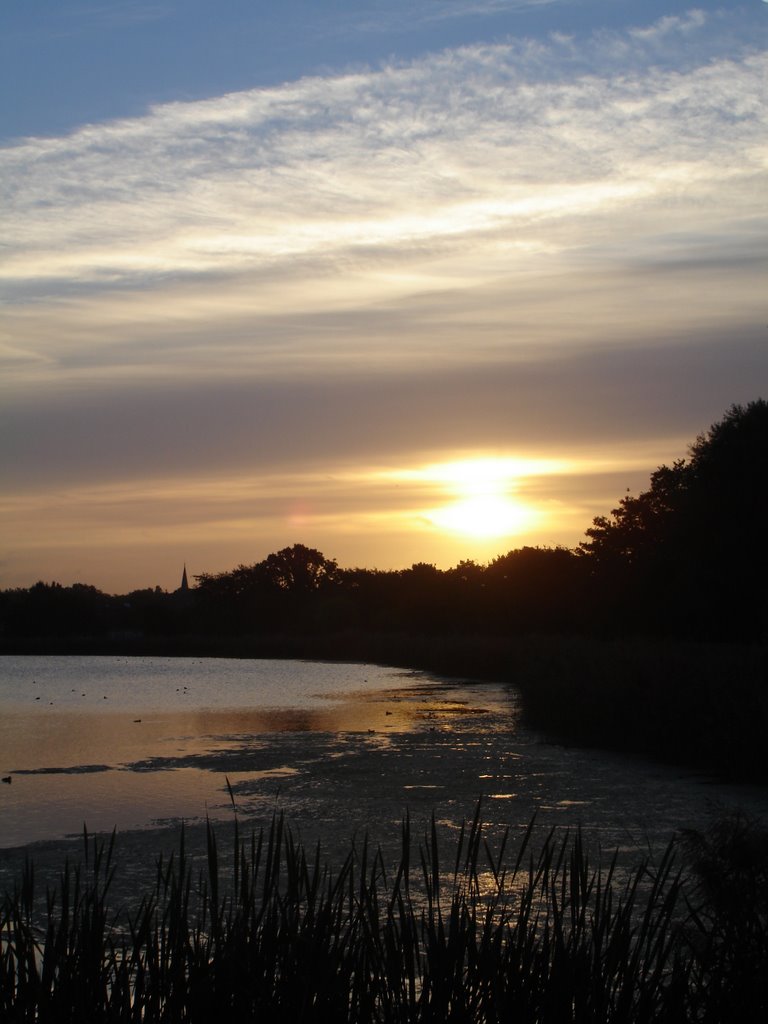
Almost the entire month (but for occasional brief showery periods) was fine, dry and mild - indeed often very warm, with the now almost expected indian summer providing pleasant watching conditions and extending the season even longer than in recent years. Winds during the period were rarely strong, and almost without exception from the southerly half of the compass.
Time spent on patch - mainly at the reservoirs, but also in Clissold Park and Abney Park Cemetery - was stepped up during the period, and several hours were dedicated to observations almost every day. Watching at the reservoirs usually began around dawn - often the case anyway, but earlier starts being even more justified on account of the time of year - and time spent in Clissold Park was either at dawn (for grounded migrants, before too much disturbance) or during the day (for flyovers).
Activity during this period was rich and varied, with a strong cast of migratory species and some real surprises. Most notable records, as expected, came from the reservoirs, with a good mix of grounded migrants, waterfowl and flyovers/visible migration.

(Wigeon & Gadwall, 21st)
Wildfowl numbers (and the list of species) continued to grow, as birds from further north and the continent used the reservoirs as a moulting site and refuelling stop. September peaks included: Common Pochard, 61 on 5th; Northern Shoveler 32 on 26th; Gadwall, 40 on several dates; Tufted Duck, 80 on 6th; Ruddy Duck - c30 on many dates; Mallard, 27 on 15th.
Uncommon and/or seasonal wildfowl records were represented by several species. The first Wigeon arrived on the 12th, with a group of seven on the ER; thereafter, numbers varied as new birds arrived and others departed, with eight on 13th, nine on 15th, seven on 17th, eight on 19th, 13 on 21st, six on 23rd, five on 26th (including two new males), and one on 29th.
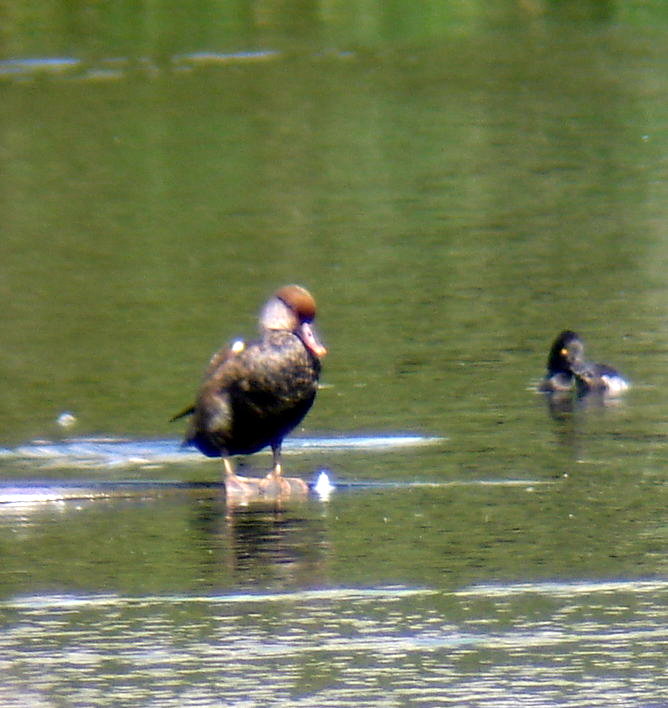
(imm. male Red-crested Pochard, 9th)
Red-crested Pochards continued their regular-as-clockwork autumnal presence, with two (immature male and female) arriving in the third week of August and remaining until at least 19th (the male being present for much of his moult from female-type plumage into less cryptic dress). With a few occasional exceptions in the winter, almost all records of this species in recent years fall within a short window of mid-August to late September.
Long overdue considering the species status in London, Egyptian Goose finally made it onto the local list, with a pair frequenting both reservoirs on the 13th, and again on the 19th and 26th. Numbers of Canada Geese swelled to record proportions, as the WR became a popular roosting site - dozens were counted leaving the site at dawn on several occasions, with top counts of 49 on 15th and 19th.
Great Crested Grebes were still attempting to breed during the last week of the month, with both birds occupying a freshly built nest; other individuals were often present, including odd juveniles on both reservoirs. Little Grebes maintained an unusually strong presence on the ER, with double figures on most days; a record 18 were recorded on the 21st. Young were still being shepherded away from gulls as late as the end of the month.
Grey Heron and Cormorant numbers swelled during the month, with often as many as 10 of the former and 40 of the latter recorded.

(Jackdaw passage, 29th)
Raptors were well represented, with Sparrowhawks being omnipresent, especially at the reservoirs; three or four individuals were often seen, and although local birds can't be ruled out, migrants were almost certainly involved. Kestrels were recorded fairly regularly, and a Peregrine early on the morning of the 17th was, perhaps surprisingly, the first record for several months.
The choice bird of prey of the month was undoubtedly Hobby; a juvenile on the 11th and an adult on the 15th both performed beautifully, giving great views over the ER. Both were recorded before 0900hrs, and neither loitered for longer than a couple of minutes.
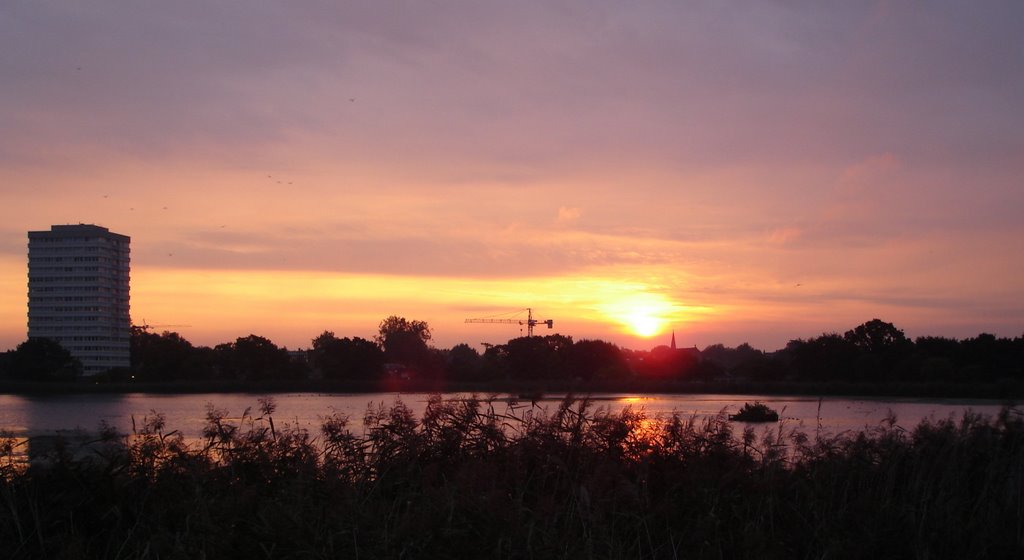
The high water levels on both reservoirs - and the overgrown state of the WR's perimeter - meant hopes of passage waders dropping in, however briefly, were lower than ever. However, the bird of the month - and one of the most unexpected records in recent times - was an immature Black-tailed Godwit, which came in low from the west, calling loudly, just after dawn on the 8th.
Much to frustration of both the observers and the bird, there was nowhere for it alight; however, four or five exploratory laps low over the ER (with half-hearted attempts to land in several unsuitable corners) were completed before the bird departed to the south-east. The only other wader record for the month came with two Common Snipe, flying fairly high and north, on the morning of the 15th.
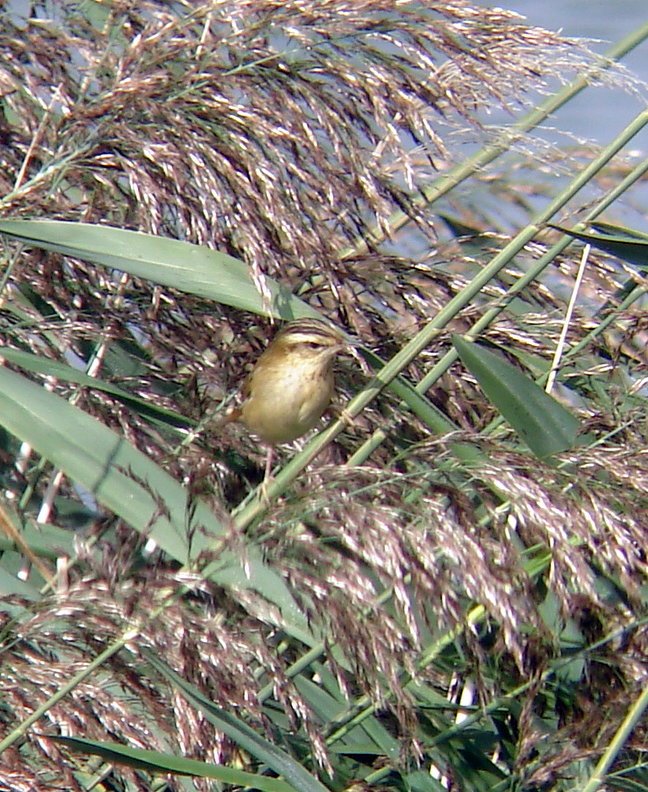
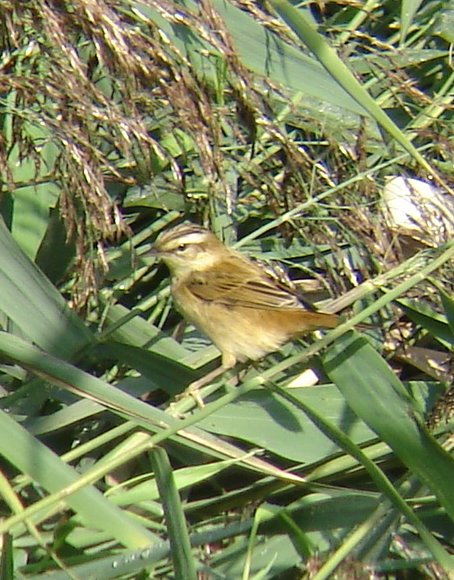
(Sedge Warbler, 23rd)
Gull numbers, and species, slowly increased as the month wore on, with Black-headeds dominating (as usual at this time of year); a handful at the beginning of the month became 15 to 30 by mid-month, and a peak of 55 on 21st was typical for the period. Lesser Black-backed Gulls were omnipresent in small numbers, usually between three and eight, and one to three Herring Gulls were recorded on most occasions.
An especially early Common Gull - an adult - was present on the gull pipes of the ER on 8th, and 2nd winters were briefly present (in the same place) on 19th and 29th. Tern passage was almost non-existent, with two Commons on 10th and, surprisingly, four Sandwich Terns on 3rd.
Woodpigeon passage was regular and prolonged during the month, with up to 200 recorded on several dates late in the month; Stock Doves also passed through in small numbers, with a peak of six on 21st. Late Common Swifts were recorded on 5th (three) and 6th (one over Clissold Park). Kingfishers were ubiquitous, with two or three seen on most visits; ditto Great Spotted and Green Woodpeckers, with at least one or two of each usually present at all sites.
Hirundines ebbed and flowed throughout the month, although with few defined peaks, and double figure counts of any of the three species were uncommon. In contrast to last September, Barn Swallows were often the most numerous, with several counts of between 10 and 15, with a peak of 19 on 19th.
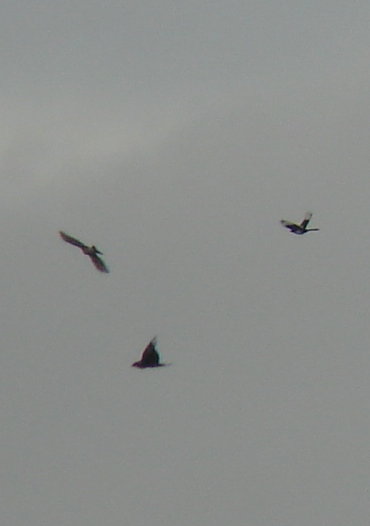
(Carrion Crow & Magpie harrassing Sparrowhawk, 29th)
House Martins were uncharacteristically scarce, with single figures at best, but for an isolated peak of 65 (also on 19th). Sand Martins were also regular but hardly numerous. (All three species were recorded on 29th, hopefully not the last of the autumn).
Skywatching for flyovers was, however, very productive. Pipits, wagtails, finches and larks complimented movements of Woodpigeons (and Starlings), and early morning sessions at the reservoirs were often rewarded with the sight and calls of relatively uncommon migrants overhead.
Species which were previously considered scarce or vagrant were encountered (through patience, and often blank hours) performing visible migration on many occasions. Generally speaking, the most productive time was from about half an hour after dawn until around 0900, and often depended on conditions; some days were blank, others were enlightened by quality, quantity or both.
Two Skylarks over on the 19th were the first of the year, but the most impressive counts involved Meadow Pipits. From the first autumn record (of three on the 15th) to the month's end, a total of 175 were recorded, eclipsing counts of previous years by many times. Peaks of 73 on 23rd and 55 on 26th were indicative of strong movements throughout the last fortnight.
Tree Pipits, previously barely annual in the area, totalled three for the month; all records, on 15th, 17th and 19th, involved calling flyovers. Wagtails of all three British species were also involved in movements; four Yellows were perhaps the highlight, with singles on 11th, 19th, 23rd and 26th.

(Spotted Flycatcher, 5th)
Both Pied and Grey Wagtails were also on the move, although counts were blurred by 'resident' birds - several of each being normally present around the reservoirs; peaks of 10 Pieds (on 23rd) and six Greys (on the 8th) probably reflected conservative counts, and both species were seen flying over at height on many occasions.
A single Northern Wheatear flew west over Clissold Park on 8th.
Robin numbers swelled during the middle of the month especially, with around 15 often recorded, usually coinciding with small influxes of Blackbirds, up to 40 of which were seen on several dates.
Song Thrushes, a fairly scarce local bird with only one confirmed breeding pair on site, also became more numerous, with up to 20 birds on several dates mid-month. Mistle Thrushes also became far more evident, with - in common with last year - presumably the same flock of up to 25 birds pre- and post-roost at the northern edge of the site.
Warblers, while rarely present in any great volumes (unlike last autumn's heavy influxes), kept things interesting, with all the common species moving through. Sedge Warblers, absent for the first ten days of the month, unexpectedly reappeared from the 11th; one's and two's were seen on several dates, with a peak of three on 23rd. One sang at dawn on 15th, and the last record was of two on 26th.
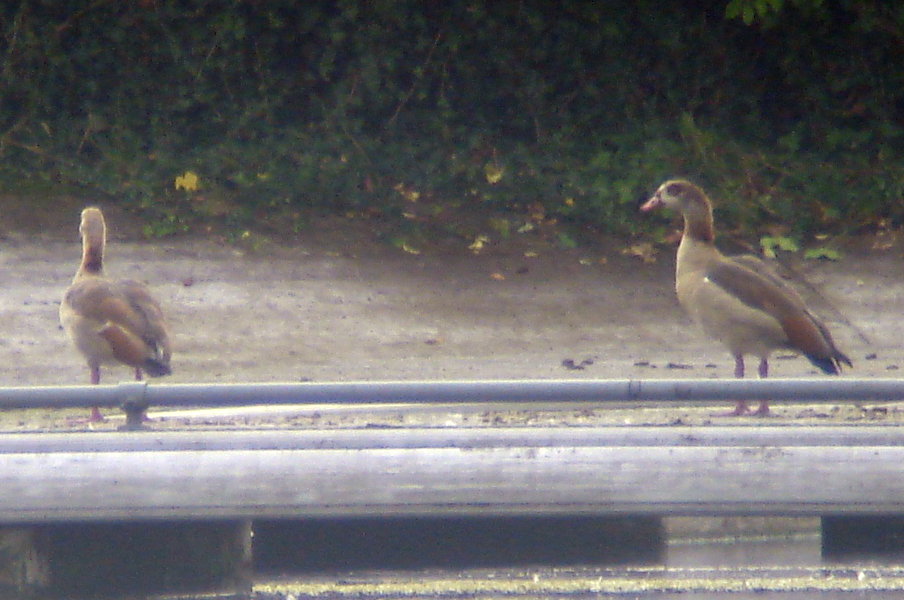
(Egyptian Geese, 13th)
Reed Warbers maintained a constant presence, with five to ten often recorded, and a peak of 12 on 12th; fewer were seen at the end of the month, but again, several birds sang on warm, clear mornings. All four Sylvia warblers were recorded, with Blackcaps predictably the most evident. One or two were seen on most occasions, with peaks of five on 5th and 8th, and three on 23rd.
A single Garden Warbler was at the ER on 13th, again, surprisingly in full song for much of the day; Lesser Whitethroats were recorded on 17th (one) and 19th (two), and a single Common Whitethroat was seen on the 5th.
Willow Warblers peaked in the first week of the month, with 18 on 5th and 12 on 8th, with numbers then decreasingly rapidly; singles were seen on most occasions thereafter, with a last record of one on 23rd.
Chiffchaffs, as expected, peaked later, and were still being recorded in fairly good numbers at the end of the month. Four to ten were not unusual throughout, with peak counts of 20 on 8th (16 at ER, 4 in CP) and 12 on 15th. Both species, once again, were singing on many occasions.
Goldcrests were typically seen or heard on about every other visit, with juveniles present on several dates mid-month. Spotted Flycatchers were a real highlight of the month, with at least eight (probably 10-12) birds recorded between 4th and 12th. Favoured sites included the deer enclosure and lakeside areas in Clissold Park, and the southern and north-eastern areas of the East Res.

(Hobby, 15th)
Tit flocks around the sites, especially along the New River east, predictably grew in strength through the month, with up to 30 Long-tailed Tits along with many Blues and Greats. Flocks often contained Phylloscopus and odd Sylvia warblers (but as yet, no Treecreeper or Firecrest....)
Corvid movements were especially evident during the last week of the month, by which time Jays numbered up to ten on several visits in and around the Oaks of the ER, and also in Abney and Clissold. Counts of Carrion Crows began to build mid-month, with up to 50 passing over on several days by the last week.

(Migrant Hawker, 9th)
Jackdaws, a scarce but regular autumn migrant, were recorded on 26th (six, west) and 29th (eight, west); two Rooks - a veritable vagrant in the area - were a pleasant surprise, also on 29th.
Starling numbers rose in accordance, often coinciding with high counts of Woodpigeons and Carrion Crows; over a hundred a day wasn't unusual by the last ten days of the month. House Sparrows remain omnipresent along the eastern fringe of the ER, where the flock presently numbers around 25.
Finches provided a few hard-earned highlights during visible migration watches (although hopefully October will provide more); Greenfinches were the commonest, with peaks of 60+ on 19th, 50 on 21st and 29th, and a 'local' flock of around 25 present from mid-month. Chaffinches were also on the move, with double figures over on some days, and more birds present around the ER by the end of the month.
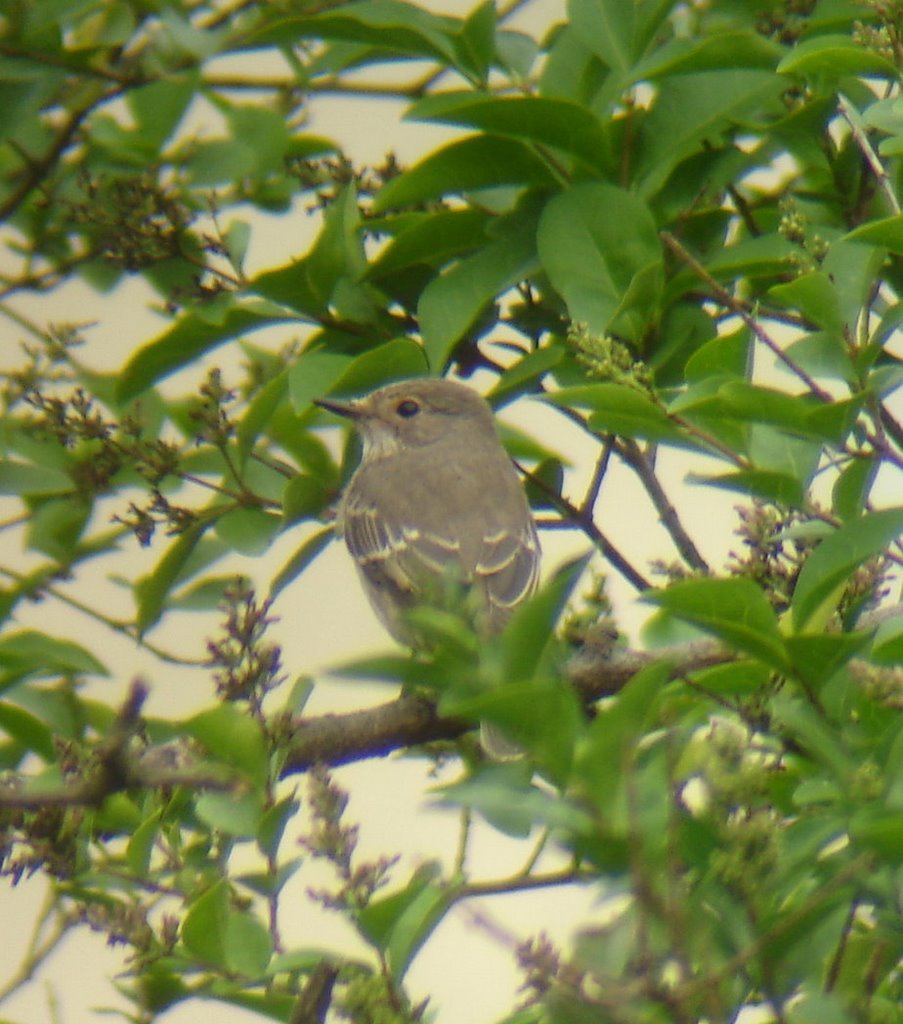
(Spotted Flycatcher, 5th)
Siskins featured comparatively well, with two on 5th, eight on 17th, seven on 19th, two on 26th and one on 29th (mostly overhead calling but occasionally grounded), while Lesser Redpolls were recorded on 26th (two by the ER) and 29th (one over). Two records of Linnets - a locally rare bird - were encouraging, with one over CP on 8th, and three over the ER on 19th.
Escapes: A blue-morph Budgerigar flew around the perimeter of the ER on 21st.
Mark
Friday, September 29, 2006
29th September 2006
Stoke Newington Reservoirs 0730-1130hrs MJP
o/c, showers, brighter spells. light S, gusting mod.
Rook - 2 east
Jackdaw - 8 west
Lesser Redpoll - 3 west
Meadow Pipit - 13 mainly sw
Siskin - 1
Barn Swallow - 11 sw
Sand Martin - 3 s
House Martin - 2 s
Chiffchaff - 2
Blackcap - 1
Sparrowhawk - 3-4
Wigeon - 1
Carrion Crow - 40+
Greenfinch - 50+
a good morning for visible migration, especially corvids - two Rooks flying west are the first of the year of this locally very rare bird, with eight Jackdaws soon after and good numbers of Carrion Crows. Other migrants evident, with hirundines and finches both moving.
The day was however overshadowed by the discovery of dead and dying swans, of the same family group on the New River west. The birds were victims of human cruelty and if anyone has any information, please leave a message here. Warm thanks to Clare, the fantastic RSPCA Inspector.
o/c, showers, brighter spells. light S, gusting mod.
Rook - 2 east
Jackdaw - 8 west
Lesser Redpoll - 3 west
Meadow Pipit - 13 mainly sw
Siskin - 1
Barn Swallow - 11 sw
Sand Martin - 3 s
House Martin - 2 s
Chiffchaff - 2
Blackcap - 1
Sparrowhawk - 3-4
Wigeon - 1
Carrion Crow - 40+
Greenfinch - 50+
a good morning for visible migration, especially corvids - two Rooks flying west are the first of the year of this locally very rare bird, with eight Jackdaws soon after and good numbers of Carrion Crows. Other migrants evident, with hirundines and finches both moving.
The day was however overshadowed by the discovery of dead and dying swans, of the same family group on the New River west. The birds were victims of human cruelty and if anyone has any information, please leave a message here. Warm thanks to Clare, the fantastic RSPCA Inspector.
Thursday, September 28, 2006
Tuesday, September 26, 2006
26th September 2006
SN Reservoirs 0700-1115hrs MJP
dull early, bright with sunny breaks after 0830. light, variable wind.

Jackdaw - 6 (w)
Egyptian Goose - 2
Yellow Wagtail - 1 (sw)
Meadow Pipit - 55 (mainly sw)
Lesser Redpoll - 2
Siskin - 2 (e)
House Martin - 7 (n)
Sedge Warbler - 2
Reed Warbler - 3+
Wigeon - 5
Sparrowhawk - 2
Chiffchaff - 6
Blackcap - 1
Shoveler - 32
Tufted Duck - 63
Woodpigeon - 200
Carrion Crow - 35
Mistle Thrush - 14

visible migration good, with several locally uncommon species moving through, including the first Jackdaws of the autumn (west), two more Siskins (east), another Yellow Wagtail (west), and two Lesser Redpolls, which briefly alighted in treetops by the ER. 55 more Meadow Pipits continue an unprecedented passage this month; most were flying south-west, again in singles and small groups (although no flocks of more than seven today) - several briefly put down, surprisingly, in phragmites as well as on short grass.
Wildfowl numbers are high, with 32 Shovelers and 63 Tufted Ducks on the ER; a third visit from the Egyptian Geese (apparently the same pair which often reside in Regent's Park) ended at 0700 when they flew south-east. Initially only three Wigeon were on the ER, perhaps reflecting the receding weed, but two more (males) came in high from the north-east around 0720.
dull early, bright with sunny breaks after 0830. light, variable wind.

Jackdaw - 6 (w)
Egyptian Goose - 2
Yellow Wagtail - 1 (sw)
Meadow Pipit - 55 (mainly sw)
Lesser Redpoll - 2
Siskin - 2 (e)
House Martin - 7 (n)
Sedge Warbler - 2
Reed Warbler - 3+
Wigeon - 5
Sparrowhawk - 2
Chiffchaff - 6
Blackcap - 1
Shoveler - 32
Tufted Duck - 63
Woodpigeon - 200
Carrion Crow - 35
Mistle Thrush - 14
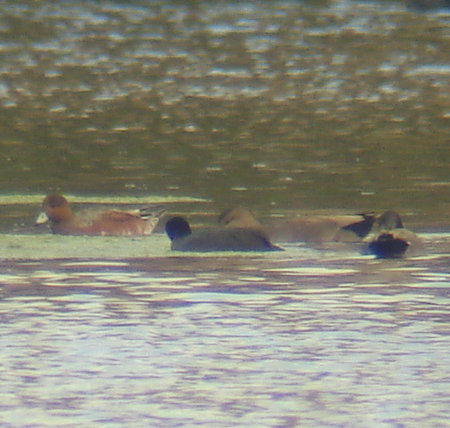
visible migration good, with several locally uncommon species moving through, including the first Jackdaws of the autumn (west), two more Siskins (east), another Yellow Wagtail (west), and two Lesser Redpolls, which briefly alighted in treetops by the ER. 55 more Meadow Pipits continue an unprecedented passage this month; most were flying south-west, again in singles and small groups (although no flocks of more than seven today) - several briefly put down, surprisingly, in phragmites as well as on short grass.
Wildfowl numbers are high, with 32 Shovelers and 63 Tufted Ducks on the ER; a third visit from the Egyptian Geese (apparently the same pair which often reside in Regent's Park) ended at 0700 when they flew south-east. Initially only three Wigeon were on the ER, perhaps reflecting the receding weed, but two more (males) came in high from the north-east around 0720.
Saturday, September 23, 2006
23rd September 2006
SN Reservoirs 0700-1145hrs MJP
misty & dull early, warm & sunny later. light SE.

Meadow Pipit - 73
Yellow Wagtail - 1
Sedge Warbler - 3
Reed Warbler - 7
Willow Warbler - 1
Chiffchaff - 8
Blackcap - 3
Pied Wagtail - 10
Grey Wagtail - 4
Barn Swallow - 16
House Martin - 5
Kingfisher - 2
Wigeon - 6
Little Grebe - 8
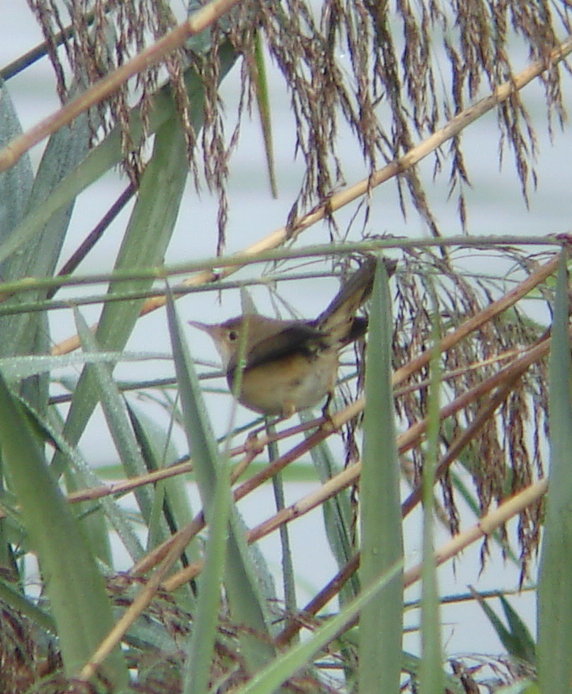
Thick mist for the first hour on patch, after which the skies slowly cleared and warm sunshine broke through from around 0845. Visible migration very impressive, although confined to a handful of species.

Meadow Pipits began moving from around 0830, in singles, small groups and larger parties (several of more than 15), and continued until around 1130; almost all flew south-west, and several singles alighted on the short grass by the ER. This is by far the largest number ever recorded in the area.

Other flyovers included another Yellow Wagtail south, four Grey Wagtails high and south-west, ten Pied Wagtails, good numbers of Greenfinch and Chaffinch, and two sp. of hirundine. Warbler passage continues to ebb and flow, with five species present, and at least three Sedge being the highlight.

Also: 2 Painted Lady, 4/5 Red Admiral and 8+ Speckled Wood.
misty & dull early, warm & sunny later. light SE.
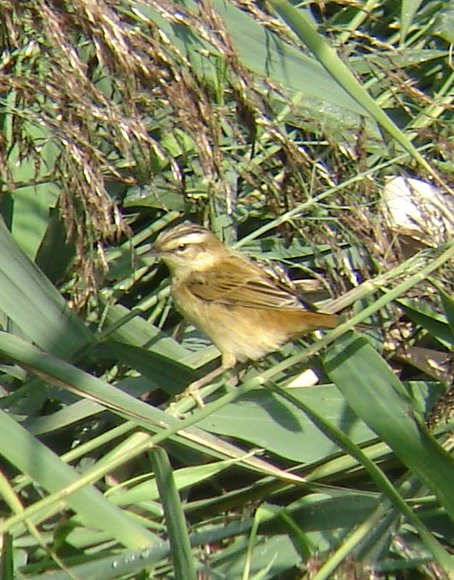
Meadow Pipit - 73
Yellow Wagtail - 1
Sedge Warbler - 3
Reed Warbler - 7
Willow Warbler - 1
Chiffchaff - 8
Blackcap - 3
Pied Wagtail - 10
Grey Wagtail - 4
Barn Swallow - 16
House Martin - 5
Kingfisher - 2
Wigeon - 6
Little Grebe - 8
Thick mist for the first hour on patch, after which the skies slowly cleared and warm sunshine broke through from around 0845. Visible migration very impressive, although confined to a handful of species.

Meadow Pipits began moving from around 0830, in singles, small groups and larger parties (several of more than 15), and continued until around 1130; almost all flew south-west, and several singles alighted on the short grass by the ER. This is by far the largest number ever recorded in the area.
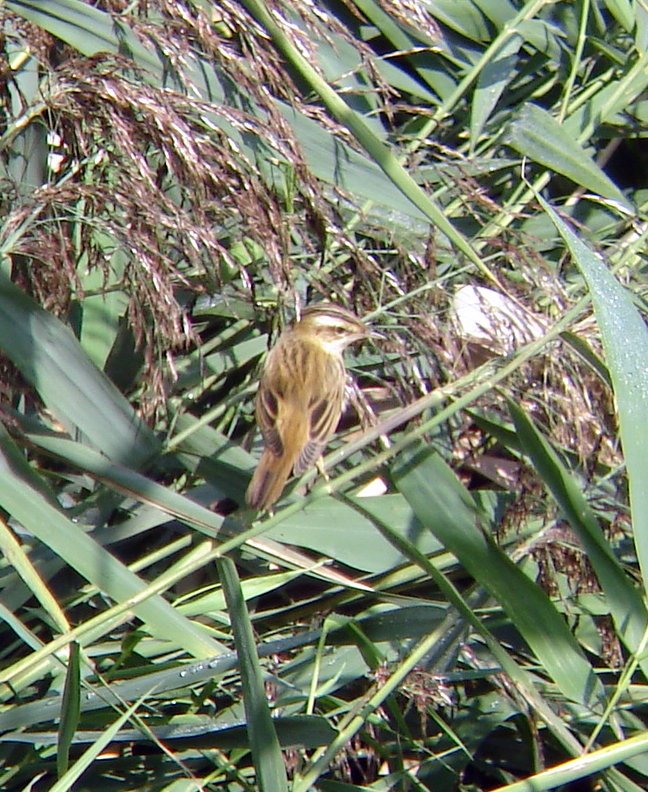
Other flyovers included another Yellow Wagtail south, four Grey Wagtails high and south-west, ten Pied Wagtails, good numbers of Greenfinch and Chaffinch, and two sp. of hirundine. Warbler passage continues to ebb and flow, with five species present, and at least three Sedge being the highlight.
Also: 2 Painted Lady, 4/5 Red Admiral and 8+ Speckled Wood.
Thursday, September 21, 2006
21st September 2006
SN Reservoirs 1415-1815hrs MJP
sunny, hot, clear. mod SW, gusting strong.

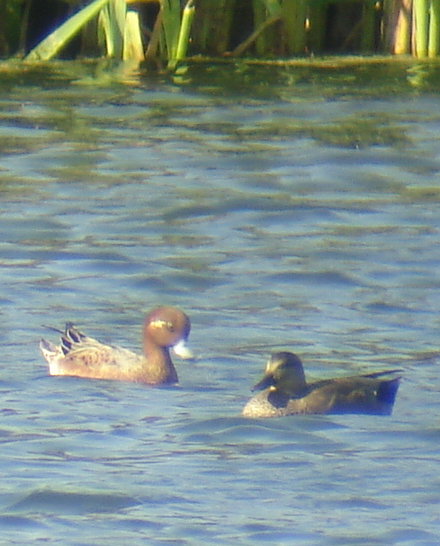
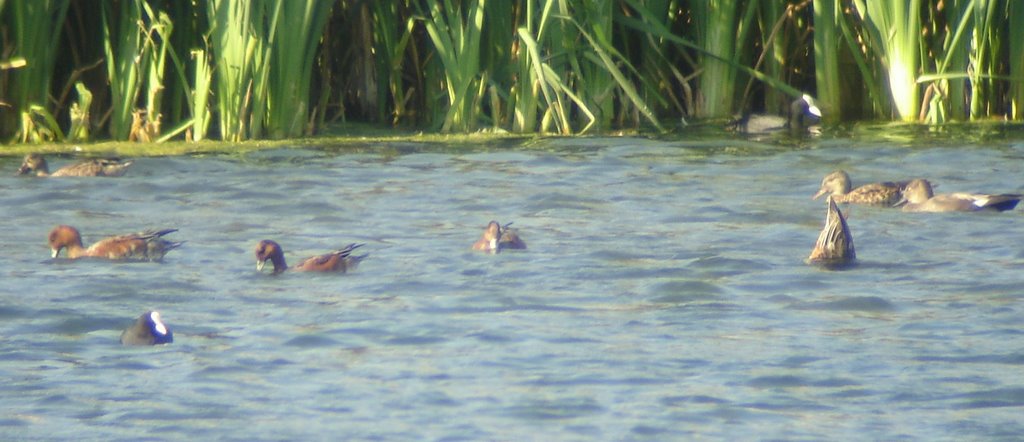
Wigeon - 13
Little Grebe - 18
Barn Swallow - 3
Meadow Pipit - 1
Chiffchaff - 2
Reed Warbler - 1
Kingfisher - 3
Black-headed Gull - 55
Herring Gull - 2
LBB Gull - 8
Cormorant - 40+
Grey Heron - 9
Kestrel - 2
Woodpigeon - c100
Greenfinch - 50+
Reed Bunting - 2
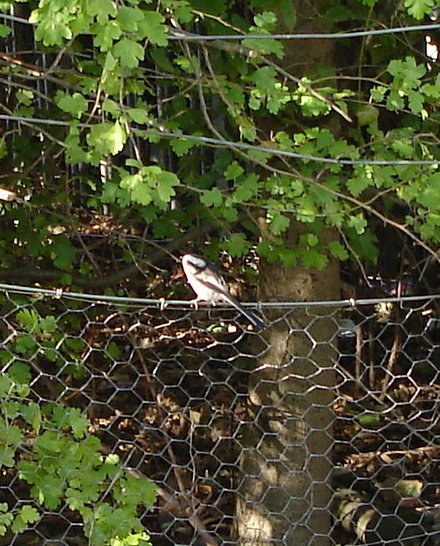
Long-tailed Tit - 22
Budgerigar - 1 (blue)!
Four hours on patch on a hot, sunny afternoon. Very little to speak of regarding visible migration or passerines (in contrast to recent days); almost nothing moving overhead but for Starlings and Woodpigeons, but time of day obviously a very influential factor.

Numbers of birds on the ER are good, with 18 Little Grebes and 13 Wigeon both being record counts for the area. Three Kingfishers are still present, at one point, all chasing each other around the reservoir perimeter, and the Long-tailed Tit flock has swelled to at least 22. Little Grebes, Ruddy Ducks and Coot all have young broods.

sunny, hot, clear. mod SW, gusting strong.
Wigeon - 13
Little Grebe - 18
Barn Swallow - 3
Meadow Pipit - 1
Chiffchaff - 2
Reed Warbler - 1
Kingfisher - 3
Black-headed Gull - 55
Herring Gull - 2
LBB Gull - 8
Cormorant - 40+
Grey Heron - 9
Kestrel - 2
Woodpigeon - c100
Greenfinch - 50+
Reed Bunting - 2
Long-tailed Tit - 22
Budgerigar - 1 (blue)!
Four hours on patch on a hot, sunny afternoon. Very little to speak of regarding visible migration or passerines (in contrast to recent days); almost nothing moving overhead but for Starlings and Woodpigeons, but time of day obviously a very influential factor.
Numbers of birds on the ER are good, with 18 Little Grebes and 13 Wigeon both being record counts for the area. Three Kingfishers are still present, at one point, all chasing each other around the reservoir perimeter, and the Long-tailed Tit flock has swelled to at least 22. Little Grebes, Ruddy Ducks and Coot all have young broods.
Tuesday, September 19, 2006
19th September 2006
SN Reservoirs 0645-1200hrs MJP
cloudy and cool early, sunny and mainly clear later. mod WNW.

flyovers:
Skylark - 2
Tree Pipit - 1
Yellow Wagtail - 1
Linnet - 3
Siskin - 7
Meadow Pipit - 14
House Martin - 65
Barn Swallow - 19
Sand Martin - 2
Woodpigeon - 230
Greenfinch - 60+
Starling - 130

Another productive and entertaining morning, mainly on account of visible migration. Most activity took place between 0700 and 0900, as on previous days, with a broad range of species moving (possibly held up last night by rain in the early hours).
The commonest species involved were Woodpigeon, Starling and Greenfinch, and highlights included the first Skylarks of the autumn, the second Yellow Wagtail and the third Tree Pipit for the year, three Linnets and a good count of Meadow Pipits.
All three hirundines moved through, with a strong passage of House Martins for the first time in several weeks.
other migrants:
Chiffchaff - 6
Lesser Whitethroat - 2
Reed Warbler - 7
Blackbird - 25

The pair of Egyptian Geese (which originally made an appearance several days ago) have returned, commuting between both reservoirs and loosely associating with Canada Geese, the latter species having increased greatly in number recently with the WR now a regular roost. Three Kingfishers at the ER simultaneously is in itself perhaps not unusual, but actually watching three simultaneously certainly is....
Two Lesser Whitethroats were feeding on berries along the New River East footpath (with a tit flock), and the second Common Gull of the autumn was present briefly on the gull pipes.
wildfowl, etc
Wigeon - 8
Little Grebe - 10
Egyptian Goose - 2
Red-crested Pochard - 2
Great Crested Grebe - 3
Canada Goose - 49
Common Gull - 1, 2nd W.
Black-headed Gull - 30
Kingfisher - 3

cloudy and cool early, sunny and mainly clear later. mod WNW.
flyovers:
Skylark - 2
Tree Pipit - 1
Yellow Wagtail - 1
Linnet - 3
Siskin - 7
Meadow Pipit - 14
House Martin - 65
Barn Swallow - 19
Sand Martin - 2
Woodpigeon - 230
Greenfinch - 60+
Starling - 130

Another productive and entertaining morning, mainly on account of visible migration. Most activity took place between 0700 and 0900, as on previous days, with a broad range of species moving (possibly held up last night by rain in the early hours).
The commonest species involved were Woodpigeon, Starling and Greenfinch, and highlights included the first Skylarks of the autumn, the second Yellow Wagtail and the third Tree Pipit for the year, three Linnets and a good count of Meadow Pipits.
All three hirundines moved through, with a strong passage of House Martins for the first time in several weeks.
other migrants:
Chiffchaff - 6
Lesser Whitethroat - 2
Reed Warbler - 7
Blackbird - 25
The pair of Egyptian Geese (which originally made an appearance several days ago) have returned, commuting between both reservoirs and loosely associating with Canada Geese, the latter species having increased greatly in number recently with the WR now a regular roost. Three Kingfishers at the ER simultaneously is in itself perhaps not unusual, but actually watching three simultaneously certainly is....
Two Lesser Whitethroats were feeding on berries along the New River East footpath (with a tit flock), and the second Common Gull of the autumn was present briefly on the gull pipes.
wildfowl, etc
Wigeon - 8
Little Grebe - 10
Egyptian Goose - 2
Red-crested Pochard - 2
Great Crested Grebe - 3
Canada Goose - 49
Common Gull - 1, 2nd W.
Black-headed Gull - 30
Kingfisher - 3

Sunday, September 17, 2006
17th September 2006
SN Reservoirs 0630-0930hrs MJP
misty and dull early, sunny later; mild. light NW.
Peregrine - 1 (east, 0815)
Tree Pipit - 1 (north, 0745)
Meadow Pipit - 16
Siskin - 8
Lesser Whitethroat - 1
Sedge Warbler - 1
Reed Warbler - 9
Willow Warbler - 1-2
Chiffchaff - 5
Grey Wagtail - 3
Sparrowhawk - 2-3
Kestrel - 1
Wigeon - 7
Red-crested Pochard - 2
Canada Goose - 23
Reed Bunting - 1
Mistle Thrush - 15
Blackbird - 45
Kingfisher - 2
Goldcrest - 2
visible migration again productive; the first day of the autumn to feature mixed finch flocks overhead, with Greenfinch and Chaffinch dominating, and 8 Siskin (one over, seven alighting in treetops with Greenfinch) the highlight. A number of flocks passed high overhead when blue skies broke through, unfortunately too high to i.d. on calls or sight.
The first Peregrine of the autumn, pursued by a Carrion Crow and heading east, was probably a young male. Pipits continue to pass through, with a total of 16 Meadow Pipits (in ones, twos and threes) and a single Tree Pipit; two of the three Grey Wags flew high overhead, suggesting migrants rather the 'resident' few.
Warblers, while not abundant, provided good variety - a Lesser Whitethroat in scrub at the ER and still-lingering Sedge being the pick. Blackbirds were numerous in the berry scrub at dawn, most having moved on by 7a.m. The group of Wigeon, present now for several days, numbered six, but were joined by a male coming in high from the NE, illustrating the 'crossover' of migrant wildfowl on site. A Reed Bunting at the ER is surprisingly the first for many weeks.
misty and dull early, sunny later; mild. light NW.
Peregrine - 1 (east, 0815)
Tree Pipit - 1 (north, 0745)
Meadow Pipit - 16
Siskin - 8
Lesser Whitethroat - 1
Sedge Warbler - 1
Reed Warbler - 9
Willow Warbler - 1-2
Chiffchaff - 5
Grey Wagtail - 3
Sparrowhawk - 2-3
Kestrel - 1
Wigeon - 7
Red-crested Pochard - 2
Canada Goose - 23
Reed Bunting - 1
Mistle Thrush - 15
Blackbird - 45
Kingfisher - 2
Goldcrest - 2
visible migration again productive; the first day of the autumn to feature mixed finch flocks overhead, with Greenfinch and Chaffinch dominating, and 8 Siskin (one over, seven alighting in treetops with Greenfinch) the highlight. A number of flocks passed high overhead when blue skies broke through, unfortunately too high to i.d. on calls or sight.
The first Peregrine of the autumn, pursued by a Carrion Crow and heading east, was probably a young male. Pipits continue to pass through, with a total of 16 Meadow Pipits (in ones, twos and threes) and a single Tree Pipit; two of the three Grey Wags flew high overhead, suggesting migrants rather the 'resident' few.
Warblers, while not abundant, provided good variety - a Lesser Whitethroat in scrub at the ER and still-lingering Sedge being the pick. Blackbirds were numerous in the berry scrub at dawn, most having moved on by 7a.m. The group of Wigeon, present now for several days, numbered six, but were joined by a male coming in high from the NE, illustrating the 'crossover' of migrant wildfowl on site. A Reed Bunting at the ER is surprisingly the first for many weeks.
Friday, September 15, 2006
15th September 2006
SN Reservoirs 0630-0915hrs MJP,LP
o/c, showers. light-mod NE.
Hobby - 1 adult, chasing hirundines, then heading N 0745
Common Snipe - 2 N, 0900
Tree Pipit - 1 N, 0730
Meadow Pipit - 3 singles over
Sand Martin - 1
Swallow - 10
Sedge Warbler - 1 (singing at dawn)
Reed Warbler - 8 (one singing)
Willow Warbler - 1
Chiffchaff - 12 (several singing)
Red-crested Pochard - 2
Wigeon - 9
Canada Goose - 49
Kingfisher - 2
Song Thrush - 15
Blackbird - 20
Mistle Thrush - 10
Robin - c15
Black-headed Gull - 25
Herring Gull - 1
LBB Gull - 4

another entertaining early morning on patch, the highlight being an adult Hobby - which came in from the east, terrorised a small group of hirundines, performed beautifully over the East Res and then departed to the north. Visible migration continues to provide, with a single Tree Pipit (the first of the year), three Meadow Pipits, two Snipe (the first for the autumn), ten Swallows and a Sand Martin all overhead.
Thrushes and Robins maintain a comparatively numerous migratory presence, and warblers are still moving through; they're also (surprisingly) singing regularly, with Sedge, Reed and chiffys all in song today (as well as Willow and Garden in the last few days).
Wildfowl numbers - especially Gadwall, Common Pochard, Shoveler and Tufted Duck - are high, and the extensive weed present on the East Res is a hit with Wigeon, nine of which are now present. The pair of Red-crested Pochards (an imm. male and a female)and two Kingfishers were also frequenting the ER; over on the WR, 49 Canada geese roosted and left at dawn (sadly bereft of any african brethren).


o/c, showers. light-mod NE.
Hobby - 1 adult, chasing hirundines, then heading N 0745
Common Snipe - 2 N, 0900
Tree Pipit - 1 N, 0730
Meadow Pipit - 3 singles over
Sand Martin - 1
Swallow - 10
Sedge Warbler - 1 (singing at dawn)
Reed Warbler - 8 (one singing)
Willow Warbler - 1
Chiffchaff - 12 (several singing)
Red-crested Pochard - 2
Wigeon - 9
Canada Goose - 49
Kingfisher - 2
Song Thrush - 15
Blackbird - 20
Mistle Thrush - 10
Robin - c15
Black-headed Gull - 25
Herring Gull - 1
LBB Gull - 4

another entertaining early morning on patch, the highlight being an adult Hobby - which came in from the east, terrorised a small group of hirundines, performed beautifully over the East Res and then departed to the north. Visible migration continues to provide, with a single Tree Pipit (the first of the year), three Meadow Pipits, two Snipe (the first for the autumn), ten Swallows and a Sand Martin all overhead.
Thrushes and Robins maintain a comparatively numerous migratory presence, and warblers are still moving through; they're also (surprisingly) singing regularly, with Sedge, Reed and chiffys all in song today (as well as Willow and Garden in the last few days).
Wildfowl numbers - especially Gadwall, Common Pochard, Shoveler and Tufted Duck - are high, and the extensive weed present on the East Res is a hit with Wigeon, nine of which are now present. The pair of Red-crested Pochards (an imm. male and a female)and two Kingfishers were also frequenting the ER; over on the WR, 49 Canada geese roosted and left at dawn (sadly bereft of any african brethren).
Wednesday, September 13, 2006
13th September 2006
SN Reservoirs 1030-1200hrs MJP,TB
humid, changeable. mod SW.

Egyptian Goose - 2
Garden Warbler - 1
Wigeon - 8
Chiffchaff - 6
Sand Martin - 2

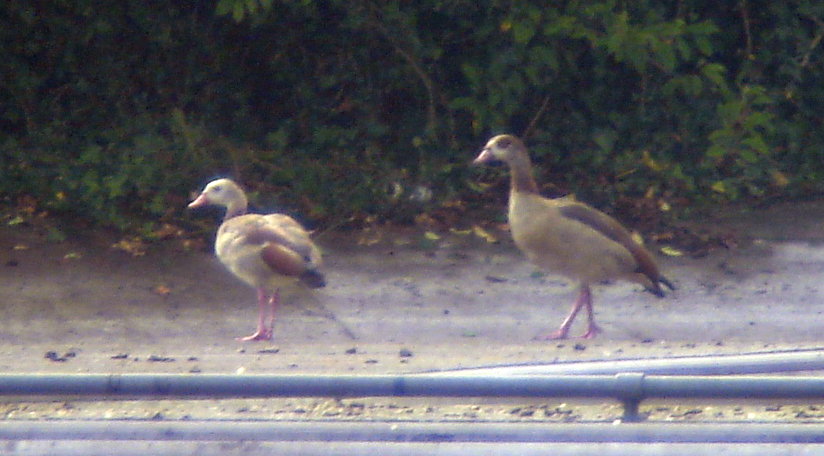
Aren't they glorious? Direct from Lake Nasser, obviously, two Egyptian Geese appeared at the Reservoirs this morning. Rather shy (thus strengthening their vagrant credentials), they commuted between the two reservoirs and could be seen easily from the New River path.
A Garden Warbler in full song in the thickets on the southern fringe of the East Res. was another nice surprise, and there are now eight Wigeon (also on the East).

(Thanks to Gary and Tony for the tip-off.)
humid, changeable. mod SW.
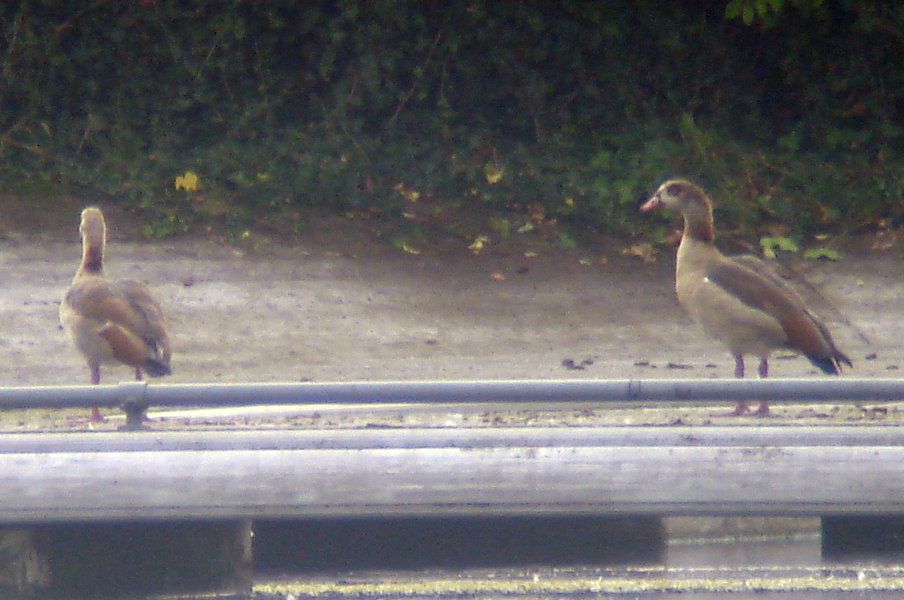
Egyptian Goose - 2
Garden Warbler - 1
Wigeon - 8
Chiffchaff - 6
Sand Martin - 2
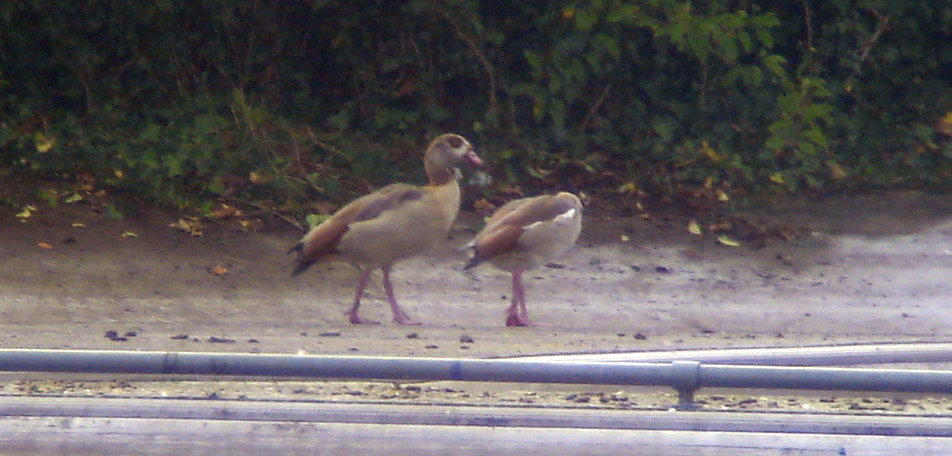
Aren't they glorious? Direct from Lake Nasser, obviously, two Egyptian Geese appeared at the Reservoirs this morning. Rather shy (thus strengthening their vagrant credentials), they commuted between the two reservoirs and could be seen easily from the New River path.
A Garden Warbler in full song in the thickets on the southern fringe of the East Res. was another nice surprise, and there are now eight Wigeon (also on the East).
(Thanks to Gary and Tony for the tip-off.)
Tuesday, September 12, 2006
12th September 2006
SN Reservoirs 0645-1110hrs MJP,LP
heavy showers early, then o/c and bright; v humid. wind v light, variable.

Wigeon - 7
Spotted Flycatcher - 3-4
Sedge Warbler - 2
Reed Warbler - 12
Chiffchaff - 16
Willow Warbler - 1
Blackcap - 1
Swallow - 11
Song Thrush - 25
Blackbird - 30
Robin - 16
Little Grebe - 11
hopes raised by overnight rain (and on patch in time for a heavy downpour), and although nothing overwhelming around, the autumn's first Wigeon were welcome, and passerine migrants had increased in numbers. At least three, possibly four, Spot Flys (all presumably new birds after several blank days at the reservoirs) continues the species' unprecedented run in the area this year.
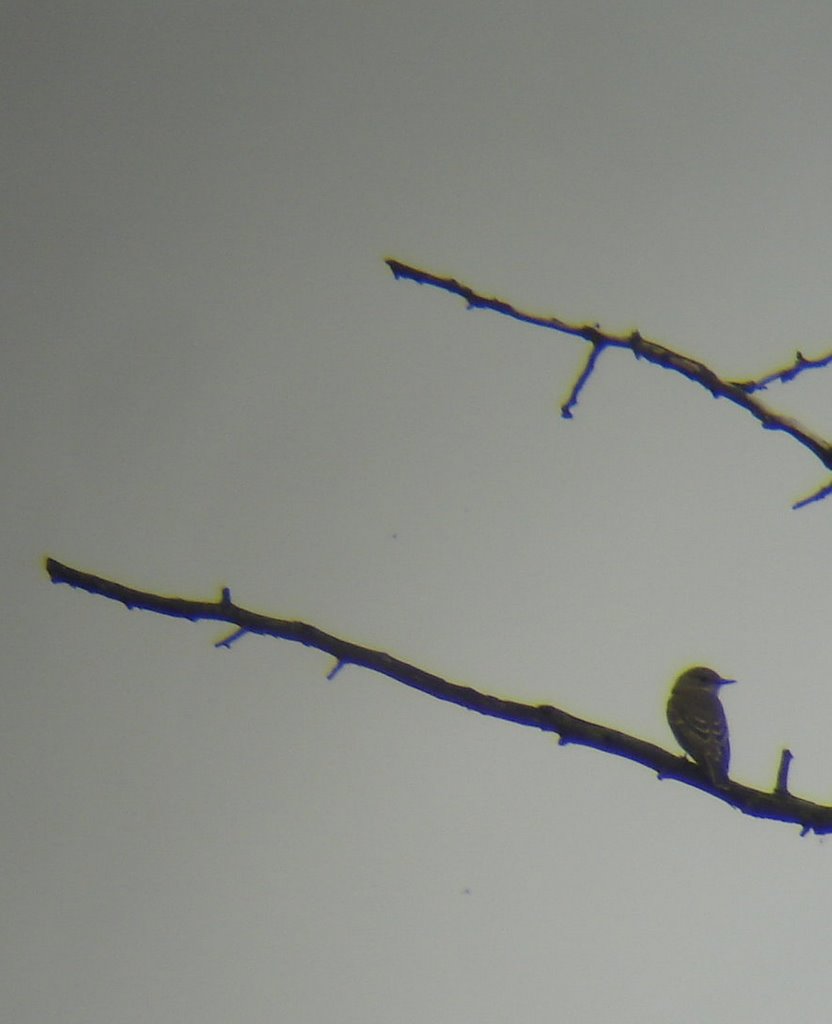
 (six of seven wigeon, East Res)
Song Thrushes, Robins and Blackbirds were present in good numbers, and eleven swallows were, suprisingly, the first hirundines (but for a lone Sand Martin on the 8th) in almost a week. Reed Warblers are presently almost everywhere around the fringe of the East Res., and at least sixteen Chiffchaffs, two Sedge Warblers, and single Willow Warbler and Blackcap made for a respectable warbler presence.
heavy showers early, then o/c and bright; v humid. wind v light, variable.
Wigeon - 7
Spotted Flycatcher - 3-4
Sedge Warbler - 2
Reed Warbler - 12
Chiffchaff - 16
Willow Warbler - 1
Blackcap - 1
Swallow - 11
Song Thrush - 25
Blackbird - 30
Robin - 16
Little Grebe - 11
hopes raised by overnight rain (and on patch in time for a heavy downpour), and although nothing overwhelming around, the autumn's first Wigeon were welcome, and passerine migrants had increased in numbers. At least three, possibly four, Spot Flys (all presumably new birds after several blank days at the reservoirs) continues the species' unprecedented run in the area this year.
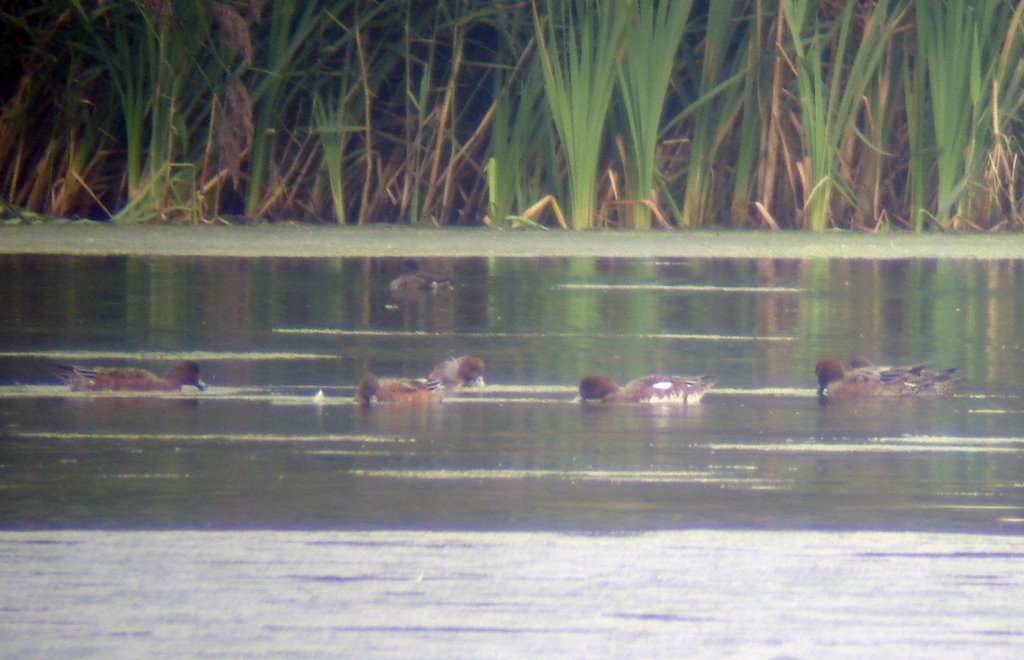 (six of seven wigeon, East Res)
Song Thrushes, Robins and Blackbirds were present in good numbers, and eleven swallows were, suprisingly, the first hirundines (but for a lone Sand Martin on the 8th) in almost a week. Reed Warblers are presently almost everywhere around the fringe of the East Res., and at least sixteen Chiffchaffs, two Sedge Warblers, and single Willow Warbler and Blackcap made for a respectable warbler presence.
Monday, September 11, 2006
11th September 2006
SN Reservoirs 0645-0900hrs MJP,LP
warm, clear, sunny. light S.
Hobby - 1 juv.
Yellow Wagtail - 1
Sedge Warbler - 1
Reed Warbler - 10
Willow Warbler - 1
Chiffchaff - 8
Blackcap - 1
Long-tailed Tit - 30+
Jay - 6+
Little Grebe - 11
Black-headed Gull - 25
Herring Gull - 2
Kingfisher - 1
Grey Wagtail - 2
Pied Wagtail - 2
Goldcrest - 4
productive and enjoyable early morning session in beautiful conditions. Yellow Wagtail over, calling and continuing south at 0725, and a cracking juvenile Hobby low overhead (and heading southeast) at 0845. Also a nice selection of warblers, with a notably late Sedge battling with chiffys in the reeds.
Wildfowl numbers remain high, although aside from the six common duck species (and the Red-crested Pochards), the autumn has yet to provide much variety.

warm, clear, sunny. light S.
Hobby - 1 juv.
Yellow Wagtail - 1
Sedge Warbler - 1
Reed Warbler - 10
Willow Warbler - 1
Chiffchaff - 8
Blackcap - 1
Long-tailed Tit - 30+
Jay - 6+
Little Grebe - 11
Black-headed Gull - 25
Herring Gull - 2
Kingfisher - 1
Grey Wagtail - 2
Pied Wagtail - 2
Goldcrest - 4
productive and enjoyable early morning session in beautiful conditions. Yellow Wagtail over, calling and continuing south at 0725, and a cracking juvenile Hobby low overhead (and heading southeast) at 0845. Also a nice selection of warblers, with a notably late Sedge battling with chiffys in the reeds.
Wildfowl numbers remain high, although aside from the six common duck species (and the Red-crested Pochards), the autumn has yet to provide much variety.
Sunday, September 10, 2006
10th September 2006
Clissold Park 1300-1830hrs MJP,GJ
warm, clear, sunny. light SE.

Spotted Flycatcher - 2
Chiffchaff - 3
Sparrowhawk - 2
Unproductive sky-watching session in the park (although hardly a chore under indian summer skies), with no overhead records to speak of; however, two more spot flys continues an excellent autumnal run.
warm, clear, sunny. light SE.

Spotted Flycatcher - 2
Chiffchaff - 3
Sparrowhawk - 2
Unproductive sky-watching session in the park (although hardly a chore under indian summer skies), with no overhead records to speak of; however, two more spot flys continues an excellent autumnal run.
Saturday, September 09, 2006
9th September 2006
SN Reservoirs 0930-1430hrs MJP,LP
Light SE, mild, sunny. some high cloud p.m.


(an accomadating Migrant Hawker, East Res., 9th Sep 2006)

Unremarkable after yesterday's shot in the arm, with few notable sightings (despite having eyes on the skies for several hours). Wildfowl numbers are still high, with Shovelers reaching an autumn peak of 36, and all other common ducks very well represented; the two Red-crested Pochards remain, with the immature male moulting into less conservative dress. 14 Little Grebes is perhaps the highest day count for a number of years; 60+ Cormorants (mainly heading west) is also a high day count.
Raptors were confined to Sparrowhawks (2) and Kestrels (2), and few passerine migrants were recorded.

Reed Warbler - 3
Chiffchaff - 4
Willow Warbler - 1
Kingfisher - 1
Jay - 5
Goldcrest - 2
Grey Wagtail - 2
Pied Wagtail - 2
Herring Gull - 2
LBB Gull - 6
Black-headed Gull - 12
Also: 4 Red Admirals, 6 Speckled Woods.
Light SE, mild, sunny. some high cloud p.m.
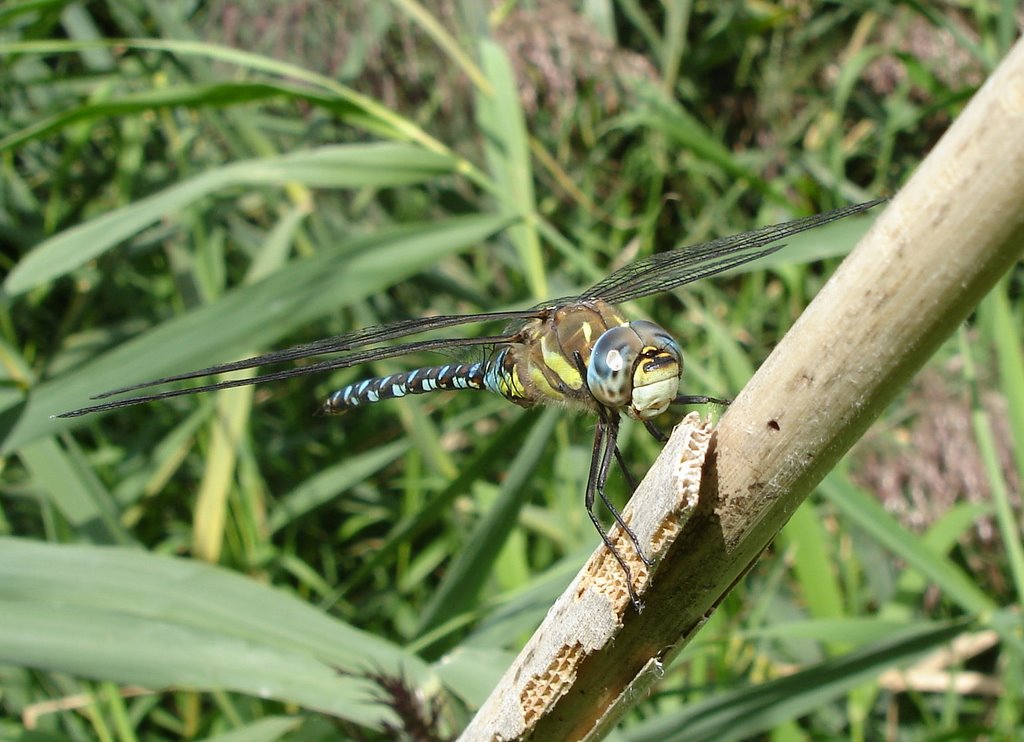
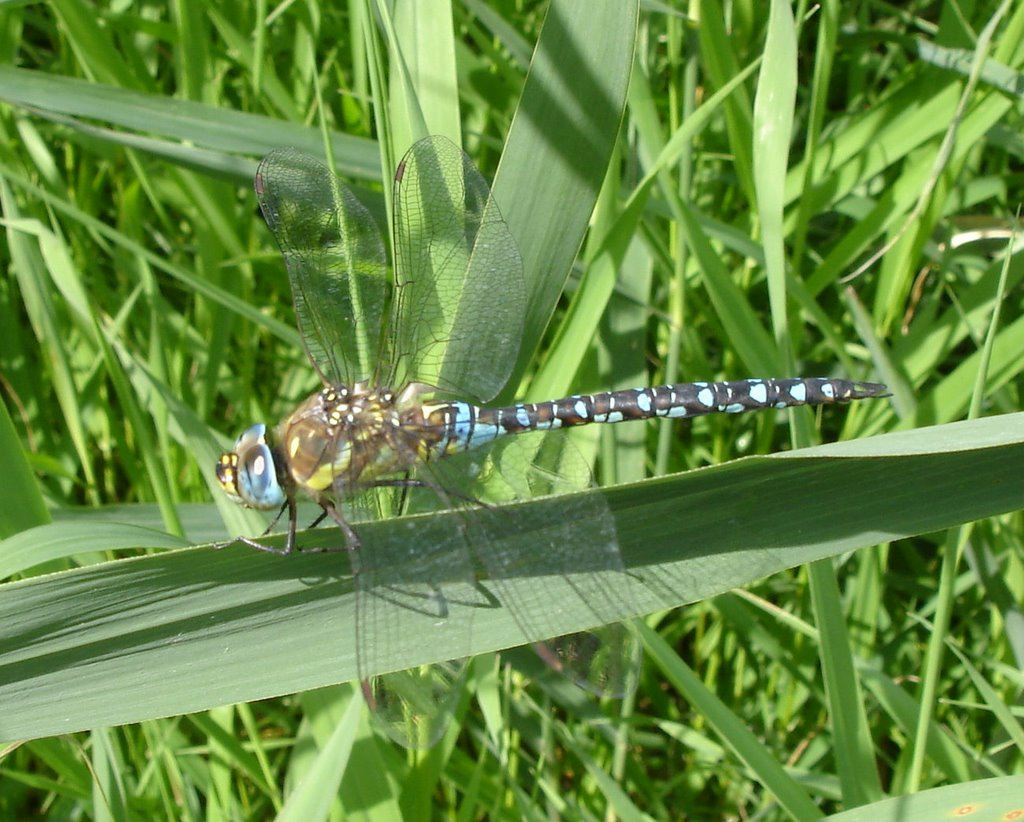
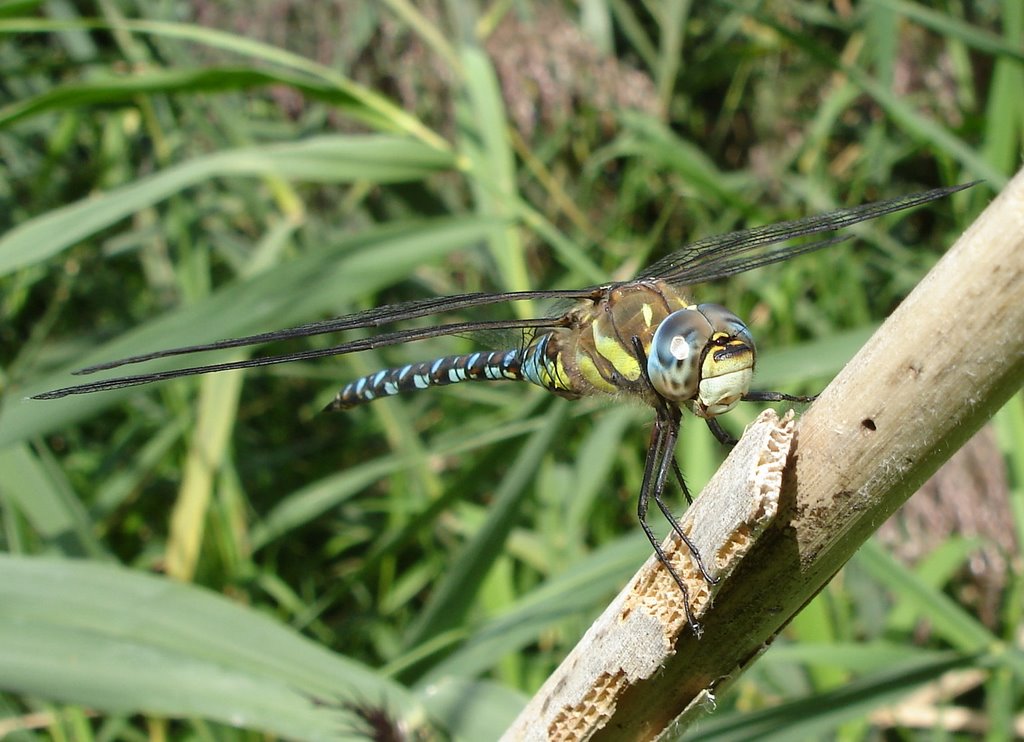

(an accomadating Migrant Hawker, East Res., 9th Sep 2006)

Unremarkable after yesterday's shot in the arm, with few notable sightings (despite having eyes on the skies for several hours). Wildfowl numbers are still high, with Shovelers reaching an autumn peak of 36, and all other common ducks very well represented; the two Red-crested Pochards remain, with the immature male moulting into less conservative dress. 14 Little Grebes is perhaps the highest day count for a number of years; 60+ Cormorants (mainly heading west) is also a high day count.
Raptors were confined to Sparrowhawks (2) and Kestrels (2), and few passerine migrants were recorded.

Reed Warbler - 3
Chiffchaff - 4
Willow Warbler - 1
Kingfisher - 1
Jay - 5
Goldcrest - 2
Grey Wagtail - 2
Pied Wagtail - 2
Herring Gull - 2
LBB Gull - 6
Black-headed Gull - 12
Also: 4 Red Admirals, 6 Speckled Woods.
Friday, September 08, 2006
8th September 2006
Stoke Newington Reservoirs and Clissold Park 0630-0930hrs
Light SE winds, cool & clear.
The first cool night-morning of the autumn so far, and hopes of something interesting were high.
Generally warbler numbers have increased, with the bias switching from Willow Warblers to Chiffchaffs, of which some of each species were in song.
Blackcaps were also more evident. Suprisingly hirundines were represented by a single Sand Martin which quickly headed south.
The first Common Gull, an adult, was present upon the 'gull pipes'.
But, our high hopes were not redeemed until an immature Black tailed Godwit came in low from the west! The bird circled low over the east reservoir, several times, almost wetting its feet. But due to ever high water levels there was no suitable areas for it to set down. It then continued south. The joy of this occurence was great and the record itself wholly unexpected. The reservoirs are almost always filled to brimming, only the exposed concrete margins of the west reservoir provide some attraction to Green and Common Sandpipers. This, and the reservoirs small size, seem to be the main reason interesting wader records are confined to the periods when they are semi drained... Which is not very often.
Laurence Pitcher and Mark Pearson.
full counts:
Clissold Park 0630-0740 (MJP,LP), & 1230-1545 (MJP)
Northern Wheatear - 1 west (at tree height), 1340
Linnet - 1 south west, 1250
Chiffchaff - 4 (a.m.)
Sparrowhawk - 1
Kestrel - 2
Long-tailed Tit - 15
Woodpigeon - 160 (a.m)
Goldfinch - c25
Stoke Newington Reservoirs 0745-0930 (MJP,LP)
Black-tailed Godwit - 1 imm.(see above)
Kingfisher - 1
Chiffchaff - 16
Willow Warbler - 12
Blackcap - 5
Reed Warbler - 1
Sand Martin - 1
Grey Wagtail - 6
Pied Wagtail - 5
Red Crested Pochard - 2
Shoveler - 23
Canada Goose - 3 (other wilfowl as is)
Common Gull - 1 ad.
Black-headed Gull - 10
Cormorant - 21
also: Speckled Woods and Red Admirals, omnipresent foxes at the res and in Abney.
additional: 2 Spotted Flycatchers, East Res., 7th Sep (TB)
Light SE winds, cool & clear.
The first cool night-morning of the autumn so far, and hopes of something interesting were high.
Generally warbler numbers have increased, with the bias switching from Willow Warblers to Chiffchaffs, of which some of each species were in song.
Blackcaps were also more evident. Suprisingly hirundines were represented by a single Sand Martin which quickly headed south.
The first Common Gull, an adult, was present upon the 'gull pipes'.
But, our high hopes were not redeemed until an immature Black tailed Godwit came in low from the west! The bird circled low over the east reservoir, several times, almost wetting its feet. But due to ever high water levels there was no suitable areas for it to set down. It then continued south. The joy of this occurence was great and the record itself wholly unexpected. The reservoirs are almost always filled to brimming, only the exposed concrete margins of the west reservoir provide some attraction to Green and Common Sandpipers. This, and the reservoirs small size, seem to be the main reason interesting wader records are confined to the periods when they are semi drained... Which is not very often.
Laurence Pitcher and Mark Pearson.
full counts:
Clissold Park 0630-0740 (MJP,LP), & 1230-1545 (MJP)
Northern Wheatear - 1 west (at tree height), 1340
Linnet - 1 south west, 1250
Chiffchaff - 4 (a.m.)
Sparrowhawk - 1
Kestrel - 2
Long-tailed Tit - 15
Woodpigeon - 160 (a.m)
Goldfinch - c25
Stoke Newington Reservoirs 0745-0930 (MJP,LP)
Black-tailed Godwit - 1 imm.(see above)
Kingfisher - 1
Chiffchaff - 16
Willow Warbler - 12
Blackcap - 5
Reed Warbler - 1
Sand Martin - 1
Grey Wagtail - 6
Pied Wagtail - 5
Red Crested Pochard - 2
Shoveler - 23
Canada Goose - 3 (other wilfowl as is)
Common Gull - 1 ad.
Black-headed Gull - 10
Cormorant - 21
also: Speckled Woods and Red Admirals, omnipresent foxes at the res and in Abney.
additional: 2 Spotted Flycatchers, East Res., 7th Sep (TB)
Wednesday, September 06, 2006
6th September 2006
SN Reservoirs 1800-2000hrs MJP, LP
very warm, some sun, some cloud. light-mod SW.
Spotted Flycatcher - 1
Common Swift - 3
Willow Warbler - 1
Reed Warbler - 1
Goldcrest - 2
Blackbird - 12
Song Thrush - 5
Mistle Thrush - 2
Starling - 50
most of the passerine migrants present yesterday have moved with today's clear skies, although another Spot Fly record (in one of the species favoured sites in the area, at the eastern end of the New River path) continues an unprecedented run this autumn. Wilfowl numbers remain high.
Canada Goose - 16
Common Pochard - 61
Shoveler - 15
Tufted Duck - c80
Ruddy Duck - c30
Mallard - 20
Gadwall - c20
Cormorant - 16
Grey Heron - 2
Great Crested Grebe - 3
Little Grebe - 9 (inc juvs)
Black-headed Gull - 25
Herring Gull - 3
LBB Gull - 8
additional: 2 Red-crested Pochards a.m (TB)
also two foxes (as is usual), several Speckled Woods and a Red Admiral.
Clissold Park 1300-1630hrs MJP
v warm, clear. light SW.
Common Swift - 1
Sand Martin - 4
House Martin - 3
Barn Swallow - 1
Sparrowhawk - 3
Grey Heron - 2
Cormorant - 7
also Small Toroiseshell - 1, Red Admiral - 1.
very warm, some sun, some cloud. light-mod SW.
Spotted Flycatcher - 1
Common Swift - 3
Willow Warbler - 1
Reed Warbler - 1
Goldcrest - 2
Blackbird - 12
Song Thrush - 5
Mistle Thrush - 2
Starling - 50
most of the passerine migrants present yesterday have moved with today's clear skies, although another Spot Fly record (in one of the species favoured sites in the area, at the eastern end of the New River path) continues an unprecedented run this autumn. Wilfowl numbers remain high.
Canada Goose - 16
Common Pochard - 61
Shoveler - 15
Tufted Duck - c80
Ruddy Duck - c30
Mallard - 20
Gadwall - c20
Cormorant - 16
Grey Heron - 2
Great Crested Grebe - 3
Little Grebe - 9 (inc juvs)
Black-headed Gull - 25
Herring Gull - 3
LBB Gull - 8
additional: 2 Red-crested Pochards a.m (TB)
also two foxes (as is usual), several Speckled Woods and a Red Admiral.
Clissold Park 1300-1630hrs MJP
v warm, clear. light SW.
Common Swift - 1
Sand Martin - 4
House Martin - 3
Barn Swallow - 1
Sparrowhawk - 3
Grey Heron - 2
Cormorant - 7
also Small Toroiseshell - 1, Red Admiral - 1.
Tuesday, September 05, 2006
5th September 2006
Stoke Newington Reservoirs 0645 - 1100hrs MJP,LP
warm, overcast. light W.

Siskin - 2
Spotted Flycatcher - 2
Red-crested Pochard - 2
Common Swift - 3
Barn Swallow - 2
House Martin - 8
Sand Martin - 6
Willow Warbler - 18
Chiffchaff - 3
Common Whitethroat - 1
Blackcap - 5
Reed Warbler - 3
Sparrowhawk - 3/4
Song Thrush - 20
Blackbird - 32
Goldcrest - 3
Starling - 100
Woodpigeon - 60
Jay - 9
enjoyable morning on patch, mainly on account of the variety of migrant passerines present - most feeding avidly on the plentiful insect supplies in warm and pleasant conditions; the Spot Flys and Siskins providing the highlights, but a good supporting cast of warblers, all three hirundines, thrushes and three late Swifts.
Also good counts of the commoner waterbirds, with duck numbers swelling significantly of late. Two Red-crested Pochards - an eclipse male and a female - are still on the West Res; almost all records last year (and in previous years) fell between mid-Aug and mid-Sep, and 2006 records appear to be going with type.

Great Crested Grebe - 4
Little Grebe - 9 (inc juvs)
Grey Heron - 5
Cormorant - 14
Canada Goose - 43
Gadwall - 25
Common Pochard - 50+
Tufted Duck - 70+
Shoveler - 19
Ruddy Duck - 27
Mallard - 20
warm, overcast. light W.
Siskin - 2
Spotted Flycatcher - 2
Red-crested Pochard - 2
Common Swift - 3
Barn Swallow - 2
House Martin - 8
Sand Martin - 6
Willow Warbler - 18
Chiffchaff - 3
Common Whitethroat - 1
Blackcap - 5
Reed Warbler - 3
Sparrowhawk - 3/4
Song Thrush - 20
Blackbird - 32
Goldcrest - 3
Starling - 100
Woodpigeon - 60
Jay - 9
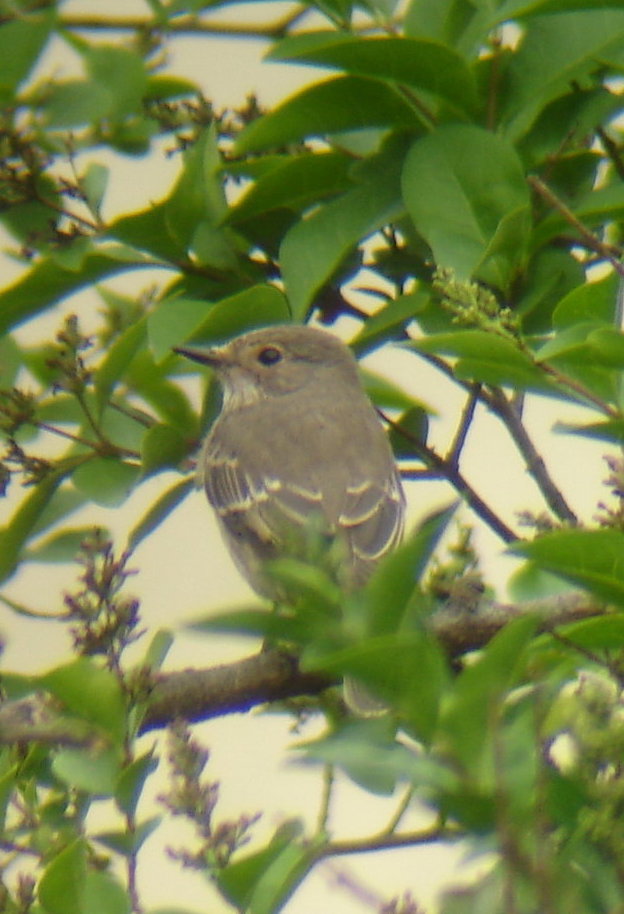
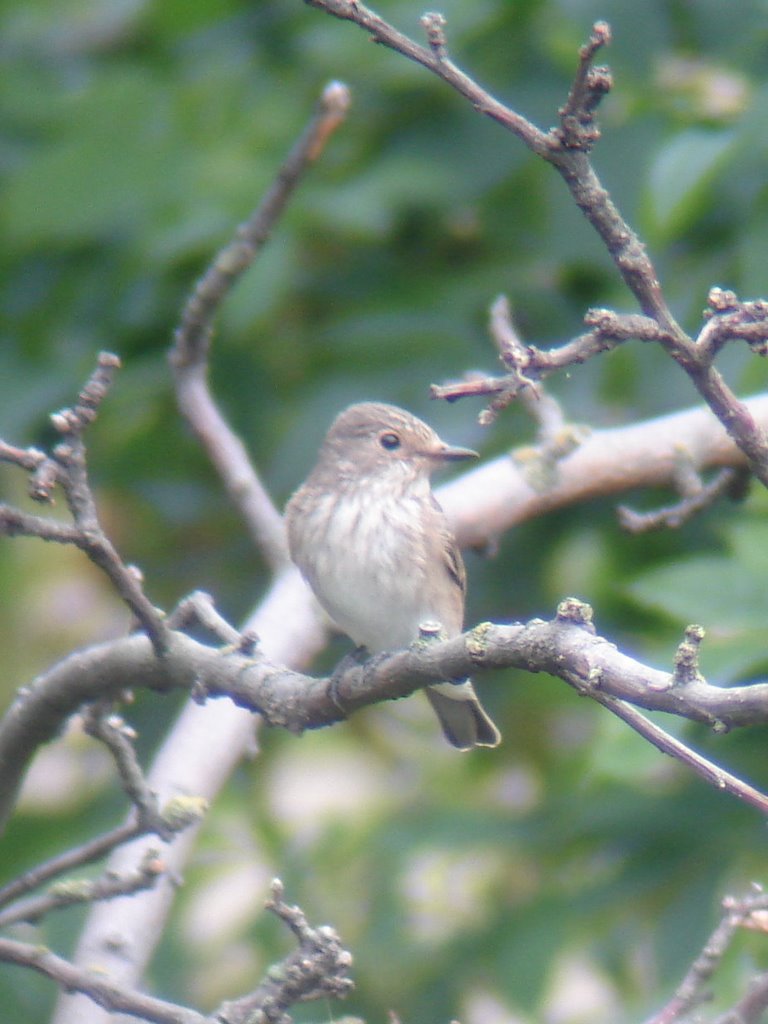
enjoyable morning on patch, mainly on account of the variety of migrant passerines present - most feeding avidly on the plentiful insect supplies in warm and pleasant conditions; the Spot Flys and Siskins providing the highlights, but a good supporting cast of warblers, all three hirundines, thrushes and three late Swifts.
Also good counts of the commoner waterbirds, with duck numbers swelling significantly of late. Two Red-crested Pochards - an eclipse male and a female - are still on the West Res; almost all records last year (and in previous years) fell between mid-Aug and mid-Sep, and 2006 records appear to be going with type.
Great Crested Grebe - 4
Little Grebe - 9 (inc juvs)
Grey Heron - 5
Cormorant - 14
Canada Goose - 43
Gadwall - 25
Common Pochard - 50+
Tufted Duck - 70+
Shoveler - 19
Ruddy Duck - 27
Mallard - 20
Monday, September 04, 2006
4th September 2006
Clissold Park 1830 - 2010hrs MJP
mild, overcast. light W.
Noctule - 1
evening walk through the park, and no birds to speak of (the circus is in town, and the park's human population has doubled to 200,000....); but a single Noctule hunted moths over the New River/deer enclosure at dusk,with several Common Pipistrelles.
(additional: reports of Imm. Northern Wheatear in Clissold Park, 4 Sandwich Terns over East Res - TeRNS)
mild, overcast. light W.
Noctule - 1
evening walk through the park, and no birds to speak of (the circus is in town, and the park's human population has doubled to 200,000....); but a single Noctule hunted moths over the New River/deer enclosure at dusk,with several Common Pipistrelles.
(additional: reports of Imm. Northern Wheatear in Clissold Park, 4 Sandwich Terns over East Res - TeRNS)
Subscribe to:
Posts (Atom)